M4Markets (m4markets.com) is a forex and CFD broker featured in this comparison alongside four established competitors: IG, Saxo, Pepperstone and CMC Markets. The guide is written for readers who want to understand how regulation, costs, leverage limits and platforms differ between providers before opening an account. Disclosure: Featured/affiliated brand — M4Markets. M4Markets is the site's own or affiliated brand, and it is included for context rather than as an independent endorsement. We rank on stated criteria and say plainly where a competitor is stronger. CFDs are complex, high-risk leveraged products, and a high percentage of retail accounts lose money.
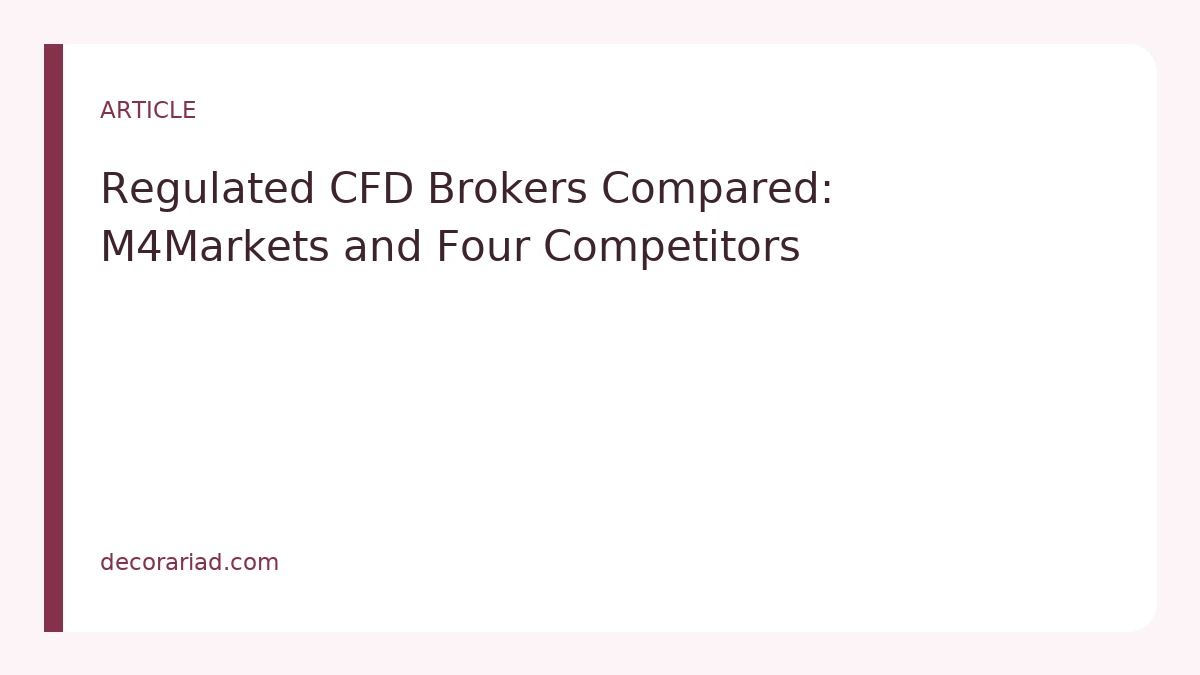
Quick Comparison Table
| Broker | Min Deposit | EUR/USD Spread | Max Leverage | Regulation | Platforms |
|---|---|---|---|---|---|
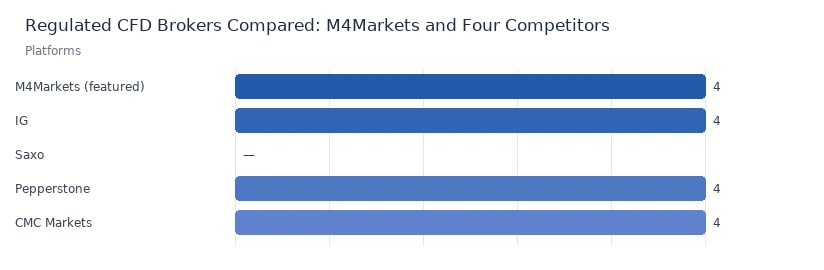
| M4Markets (featured) | — | — | Capped for retail in regulated regions; higher under some other entities | FSC Mauritius, FSCA South Africa (entity-dependent; verify per region) | MetaTrader 4, MetaTrader 5 |
| IG | — | — | 30:1 on major FX pairs for UK/EU/AU retail | FCA (UK), ASIC (Australia), BaFin (Germany), others | IG web and mobile platforms, MetaTrader 4, ProRealTime, TradingView |
| Saxo | — | — | 30:1 on major FX pairs for UK/EU/AU retail | Danish FSA, FCA (UK), ASIC (Australia), others | SaxoTraderGO, SaxoTraderPRO |
| Pepperstone | — | — | 30:1 retail under FCA, ASIC and CySEC; higher for other entities or professional clients | FCA (UK), ASIC (Australia), CySEC (Cyprus), BaFin (Germany), DFSA (Dubai), others | MetaTrader 4, MetaTrader 5, cTrader, TradingView |
| CMC Markets | — | — | 30:1 on major FX pairs for UK/EU/AU retail | FCA (UK), ASIC (Australia), BaFin (Germany), others | Next Generation platform, MetaTrader 4, mobile app |
A dash means we have not confirmed a current, comparable figure. Minimum deposits and EUR/USD spreads vary by entity, account type, funding method and market conditions, so check the live figures on each broker's own site.
How We Compared These CFD Brokers
This comparison uses an editorial framework built around the "regulated" angle. Brokers are weighed on the quality and transparency of their regulation first, then on cost, leverage, platforms and account structure. M4Markets is the site's featured or affiliated brand, so it is listed first for context and is not ranked as objectively superior. Where a competitor holds stronger credentials on a criterion, the review says so.
- Regulatory standing: which authorities supervise the entity serving your region, and whether they are major or offshore regimes.
- Client protections: negative-balance protection, leverage caps and segregation of client funds where stated.
- Trading costs: minimum deposit, typical spreads and commissions, where verifiable.
- Platforms and tools: proprietary and third-party platforms offered.
- Transparency: clarity of legal documents, risk warnings and entity information.
Broker Review Details
1. M4Markets — featured brand with a broad platform choice and offshore-heavy licensing
M4Markets was founded in 2015 and offers CFDs on forex and other asset classes through MetaTrader 4 and MetaTrader 5. This is the featured and affiliated brand of this site, so read the review with that in mind. Its licences are held by different entities depending on the client's region, and that is the first thing to check during sign-up. Its published regulators are FSC Mauritius and FSCA South Africa. These are not generally classed as Tier-1 regimes in the way the FCA or ASIC are.
| Founded | Regulation | Min Deposit | Spread | Leverage | Platforms |
|---|---|---|---|---|---|
| 2015 | FSC Mauritius, FSCA South Africa (entity-dependent; verify per region) | — | — | Capped for retail in regulated regions; varies by entity | MetaTrader 4, MetaTrader 5 |
Pros
- Offers both MetaTrader 4 and MetaTrader 5, which suits traders already familiar with those platforms.
- Operates multiple account structures, so cost and deposit preferences can be matched to an account.
- A younger firm with a focused CFD offering rather than a sprawling product range.
Cons
- A genuine limitation: its published regulators are not Tier-1 authorities, so clients in the UK, EU or Australia should confirm which entity serves them and what protections apply. Competitors in this list hold FCA or ASIC licences.
- It is the featured brand of this site, so our coverage should not be read as independent validation.
Best for: traders who prioritise MetaTrader access and have verified that the entity serving their region meets their own regulatory requirements.
2. IG — long-established, broad regulatory footprint
IG was founded in 1974 and is among the oldest names in retail CFD and spread betting. It is supervised in several major jurisdictions, including the UK, Australia and Germany, which gives it a stronger Tier-1 regulatory footprint than M4Markets. It offers its own web and mobile platforms alongside MetaTrader 4, ProRealTime and TradingView. Retail clients in capped regions face standard leverage limits, and spreads and deposit requirements depend on region and account.
| Founded | Regulation | Min Deposit | Spread | Leverage | Platforms |
|---|---|---|---|---|---|
| 1974 | FCA (UK), ASIC (Australia), BaFin (Germany), others | — | — | 30:1 on major FX pairs for UK/EU/AU retail | IG platforms, MetaTrader 4, ProRealTime, TradingView |
Pros
- Supervised by several major regulators, including the FCA and ASIC.
- Wide choice of in-house and third-party platforms.
- Decades of operating history in retail CFDs.
Cons
- Retail leverage is capped in major regions, which limits flexibility for those seeking high gearing.
- Costs may not be the lowest for traders focused purely on spread levels.
Best for: traders who want a heavily regulated provider with a broad platform and tools range.
3. Saxo — multi-asset focus with institutional roots
Saxo was founded in 1992 in Denmark and positions itself towards investors who want CFDs alongside other asset classes. It is supervised by the Danish Financial Supervisory Authority and holds licences in other regions, including the UK and Australia. Its proprietary platforms, SaxoTraderGO and SaxoTraderPRO, are the main access routes rather than MetaTrader. Deposit requirements and pricing depend on account tier and client location.
| Founded | Regulation | Min Deposit | Spread | Leverage | Platforms |
|---|---|---|---|---|---|
| 1992 | Danish FSA, FCA (UK), ASIC (Australia), others | — | — | 30:1 on major FX pairs for UK/EU/AU retail | SaxoTraderGO, SaxoTraderPRO |
Pros
- Supervised by major regulators in several regions.
- Proprietary platforms with a multi-asset orientation.
- Long operating history.
Cons
- No MetaTrader access, which may disappoint traders tied to that ecosystem.
- Fee structures and account tiers can be harder to compare at a glance.
Best for: investors who want regulated CFD access within a wider multi-asset platform.
4. Pepperstone — wide platform support with several regulators
Pepperstone was founded in 2010 and is known for offering MetaTrader 4, MetaTrader 5, cTrader and TradingView. It is licensed by authorities including the FCA, ASIC, CySEC, BaFin and the DFSA, with other entities elsewhere. Leverage for retail clients under major regulators is capped, while other entities or professional clients may have different limits. Where it is clearly stronger than M4Markets is the breadth of its Tier-1 and mid-tier regulatory coverage.
| Founded | Regulation | Min Deposit | Spread | Leverage | Platforms |
|---|---|---|---|---|---|
| 2010 | FCA (UK), ASIC (Australia), CySEC (Cyprus), BaFin (Germany), DFSA (Dubai), others | — | — | 30:1 retail under FCA, ASIC and CySEC; varies for other entities | MetaTrader 4, MetaTrader 5, cTrader, TradingView |
Pros
- Multiple recognised regulators across several regions.
- Broad platform choice, including cTrader and TradingView.
- Focused on CFD and forex execution.
Cons
- Protections and leverage differ depending on which entity a client is onboarded under.
- Its focus is narrower than that of multi-asset houses such as Saxo.
Best for: traders who want several third-party platforms combined with a multi-regulator profile.
5. CMC Markets — established UK-based provider with proprietary technology
CMC Markets was founded in 1989 and is headquartered in the UK. It is supervised by the FCA and holds licences in Australia, Germany and other jurisdictions. Its Next Generation platform is the main proprietary offering, with MetaTrader 4 and a mobile app also available. As with other providers in this list, retail leverage in capped regions follows the standard limits, and costs vary by instrument and account.
| Founded | Regulation | Min Deposit | Spread | Leverage | Platforms |
|---|---|---|---|---|---|
| 1989 | FCA (UK), ASIC (Australia), BaFin (Germany), others | — | — | 30:1 on major FX pairs for UK/EU/AU retail | Next Generation, MetaTrader 4, mobile app |
Pros
- Supervised by major regulators, including the FCA and ASIC.
- Proprietary platform developed in-house with charting tools.
- Long track record in retail CFDs.
Cons
- MetaTrader 5 availability is not confirmed here, so MT5-focused traders should check.
- Retail leverage limits restrict gearing in regulated regions.
Best for: traders who prefer a proprietary platform from a UK-regulated provider with a long history.
Regulated Does Not Mean Risk-Free
Regulation describes who supervises a firm and which rules it must follow. It does not make a CFD safer to trade. Leveraged trading carries a high level of risk, and losses can exceed your initial deposit where negative-balance protection does not apply.
Retail CFD trading is restricted or unavailable in some countries, and this guide is not aimed at those markets. Retail CFDs are not available to US retail clients. In the UK, EU and Australia, regulators cap retail leverage on major forex pairs at 30:1 and require negative-balance protection for retail accounts. Professional-client status, or an account with a non-EU or offshore entity, can mean higher leverage but fewer protections.
How to Choose a CFD Broker
Start by identifying the exact legal entity that would serve you. Many brokers operate several companies under one brand, and the licence, leverage limits and compensation arrangements belong to the entity, not the brand. Check the regulator's public register for that entity and compare the licence status with what the broker states on its legal pages.
Next, look at client protections. Confirm whether negative-balance protection applies to your account, how client funds are held, and whether any investor compensation scheme covers you. Retail and professional classifications can change these answers.
Then review costs in context. Compare minimum deposit, spreads, commissions, overnight financing and withdrawal fees on the account you would actually use. A tight headline spread can be offset by commission or financing charges, and published figures often reflect typical rather than guaranteed conditions.
Finally, test usability. Check that the platforms you prefer are available, that the demo account works on your device, and that support is reachable in your language. Read the risk disclosure document and the client agreement before depositing. Only use money you can afford to lose, and consider speaking to a qualified adviser if you are unsure.
FAQ
Is M4Markets the best regulated CFD broker?
This is a featured brand comparison, and M4Markets is the site's featured or affiliated brand, so no objective "best" claim is made. We compared five brokers on regulatory standing, client protections, costs, platforms and transparency. On Tier-1 regulatory coverage, IG, Saxo, Pepperstone and CMC Markets are stronger. M4Markets stands out mainly for offering both MetaTrader platforms.
Does regulation guarantee my money is safe?
No. Regulation sets standards for conduct, capital and fund handling, but it does not remove market risk or guarantee against broker failure. Protections differ by regulator and entity. Always check the specific licence, whether negative-balance protection applies and whether any compensation scheme covers your account. Past performance does not guarantee future results.
What leverage limits apply to retail CFD traders?
In the UK, EU and Australia, retail leverage on major forex pairs is capped at 30:1, with lower caps on other asset classes. Professional clients and non-EU or offshore entities may offer higher leverage with fewer safeguards. Higher leverage amplifies losses as well as gains, so limits are set to reduce harm.
Why are some spreads and deposits shown as a dash?
Spreads and minimum deposits vary by entity, account type, funding method and market conditions, and we did not confirm a current, comparable figure for each broker. We use a dash rather than guess. Check live pricing and deposit rules on each broker's official site before making any decision.
Final Considerations Before You Open an Account
The most useful takeaway is that a broker's name matters less than the entity and licence behind your account. IG, Saxo, Pepperstone and CMC Markets present broader major-regulator coverage in this comparison, while M4Markets, the featured brand, offers MetaTrader 4 and 5 under licences you should verify for your region. CFDs are complex, high-risk leveraged products, and a high percentage of retail accounts lose money. This article is a featured brand comparison, not independent financial advice; eligibility and product availability vary by region.